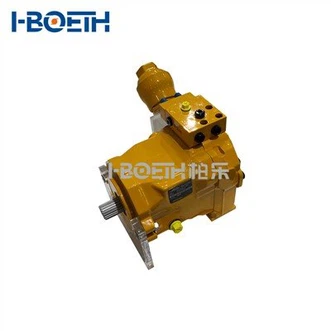


Axial piston pumps can be divided into two categories: end face distribution (that is, distribution plate distribution) and valve distribution according to their distribution mode. The axial piston pump of distribution plate distribution can be divided into two categories: swash plate type (also known as straight shaft type) and oblique shaft type (also known as swing cylinder type) according to its structural characteristics. Swash plate pumps are a bit of contact type and sliding shoe type, as well as non-thru-shaft (half-shaft) type and thru-shaft type.
First, the valve distribution axial piston pump is the valve distribution axial piston pump working principle diagram. The rotation of the swash plate 1 forces the plunger 2 to make axial reciprocating motion. When the plunger 2 changes the direction of movement at the end of the stroke, the check valves 4 and 5 will automatically open and close with the decrease of pressure in the suction process pump chamber and the increase of pressure in the process pump chamber to achieve flow distribution. The advantage of this distribution method is that the valve distribution can be carried out automatically, the higher the pressure, the tighter the valve closes, the less leakage, and the lubrication performance of the hydraulic pressure is low. In fact, valve distribution axial piston pump hydraulic transmission is not common, and the reasons are as follows:
1) The unidirectional nature of the distribution valve makes the plunger pump lose its reversibility and cannot be used as a hydraulic motor. The hydraulic pump is driven by a high-speed prime mover. When it works at high speed, the valve is prone to impact and action hysteresis during the opening and closing process.
2) In order to make the structure compact and the flow uniform, the plunger hydraulic pumps are all multi-plunger structure. The structure is more complex due to the requirement to be equipped with twice the number of piston valves. However, when providing ultra-high pressure or conveying media with low viscosity and poor lubrication performance (such as water, high water-based media, etc.), the valve distribution axial piston pump has very good adaptability; In addition, it also has good anti-pollution performance. At present, almost all ultra-high pressure sea (light) water hydraulic pumps produced at home and abroad adopt the form of valve distribution.
Second, swash plate (straight shaft) axial piston pump
1. Working principle The working principle of swash plate axial piston pump. The plunger 3 is mounted in an evenly distributed plunger bore within the cylinder block 4, and the head of the plunger 3 is mounted with a sliding shoe
2. Due to the role of the return mechanism, the bottom of the sliding shoe is always attached to the surface movement of the swash plate 1. The surface of the swash plate has an inclination angle relative to the plane of the cylinder block (A-A surface), and when the cylinder block 4 drives the plunger to rotate, the plunger reciprocates in a straight line in the plunger hole. In order to make the movement of the plunger and the switching of the oil suction circuit and the pressure oil circuit achieve accurate coordination, a fixed flow distribution component is placed between the distribution end face of the cylinder block and the oil suction channel and the pressure oil channel of the pump - distribution plate 5. There are two arc-shaped channels on the distribution plate, that is, the waist-shaped distribution window. The front of the distribution plate and the end face of the cylinder block are closely fitted and slide relative to each other; On the back of the distribution plate, the two waist-shaped distribution windows should be connected with the oil suction circuit and pressure oil circuit of the pump respectively. If the cylinder block rotates in the direction shown, in the range of 0~180, the plunger starts to extend from the upper dead center (corresponding to the 0 position), and the plunger cavity volume continues to expand until the lower dead center (corresponding to the 180 position). In this process, the plunger cavity is connected to the oil absorption window of the distribution plate 5, and the oil is continuously sucked into the plunger cavity, which is the oil absorption process. As the cylinder continues to rotate, in the range of 180~360, the plunger starts to retract into the cavity from the lower dead center under the constraint of the swash plate, and the volume of the plunger cavity continues to decrease, until the upper dead center. In this process, the plunger cavity is just connected to the oil pressure window of the distribution plate 5, and the oil is discharged through the oil pressure window, which is the oil pressure process. It can be seen that every revolution of the cylinder block, each plunger carries out half-cycle oil absorption and half-cycle oil pressure. If the piston pump rotates continuously, it can continuously absorb and press oil. Changing the inclination of the swash plate changes the displacement of the piston pump.